
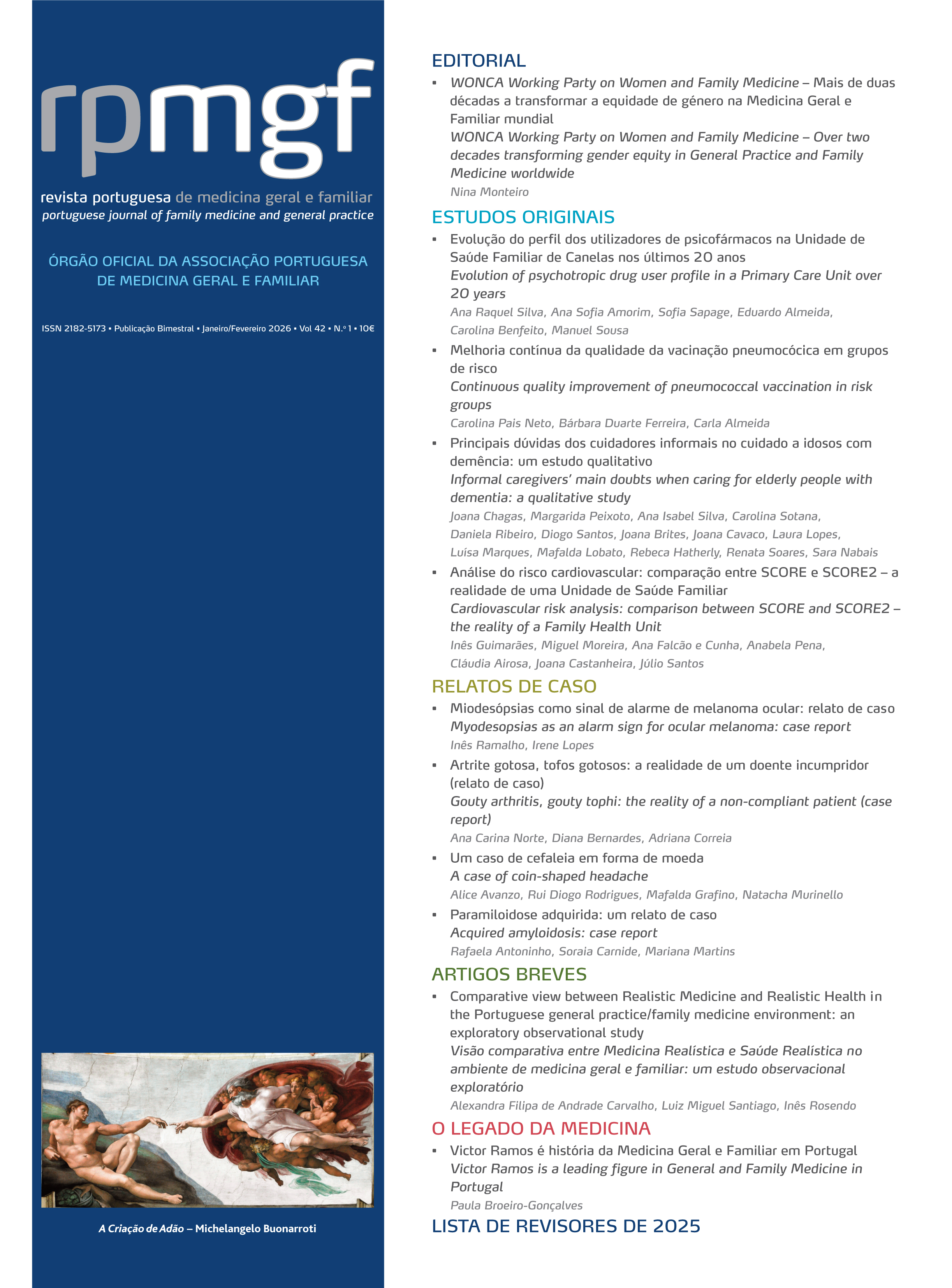
Comparative view between Realistic Medicine and Realistic Health in the Portuguese general practice/family medicine environment: an exploratory observational study
DOI:
https://doi.org/10.32385/rpmgf.v42i1.14212Palabras clave:
Realistic Medicine, Realistic Health, General practice, Family medicineResumen
Introduction: Realistic Medicine (RM) and Realistic Health (RH) are two concepts related to physicians' approaches to patient care.
Objectives: To assess the opinions of Portuguese general and family medicine (GP/FM) doctors regarding the criteria of RM and RH.
Methods: Following ethical and authorship approvals, a validated specific questionnaire, its responding invitation in mailing lists in 2023 and 2024, with context variables sex, age, being a medical resident of specific training in MGF (MIFE-GP) or a specialist doctor (E-GP), and type of health unit of work (USF or UCSP) were observed and made. Informed consent, a single anonymous response, on a 1 to 5 points Likert scale, 5 (strongly agree). Total scores ranged from [10 to 50] for RH and [6 to 30] for RM. Descriptive and inferential non-parametric analyses were performed.
Results: A n=130 convenience sample, 64.3% women, 74.6% working in the USF model, 28.5% under 34 years, and 46.9% between 35 and 54 years, and 15.4% being MIFE-GP, was studied. The RM score between MIFE-GP and E-GP, the latter scoring higher, was different, p=0.032. “Do you consider that Realistic Medicine is similar to Realistic Health?” was different for sex (p=0.037) and age group (p=0.039), with men and older respondents more likely to recognize the difference. A moderate positive correlation between RM and RH scores for E-GP, r=0.497, p<0.001, and a weak positive one for MIFE-GP, r=0.277, p=0.237, were found.
Discussion/Conclusion: This unprecedented and exploratory study revealed a lack of conceptual clarity among respondents regarding RM and RH, particularly among MIFE-GP, about the broader RH.
Descargas
Referencias
1. Bunker JP. The role of medical care in contributing to health improvements within societies. Int J Epidemiol. 2001;30(6):1260-3.
2. Cutler DM, McClellan M. Is technological change in medicine worth it? Health Aff (Millwood). 2001;20(5):11-29.
3. Macinko J, Starfield B, Shi L. The contribution of primary care systems to health outcomes within Organization for Economic Cooperation and Development (OECD) countries, 1970-1998. Health Serv Res. 2003;38(3):831-65.
4. Kaplan RM, Milstein A. Contributions of health care to longevity: a review of 4 estimation methods. Ann Fam Med. 2019;17(3):267-72.
5. Oeppen J, Vaupel JW. Demography: broken limits to life expectancy. Science. 2002;296(5570):1029-31.
6. Thiyagarajan JA, Mikton C, Harwood RH, Gichu M, Gaigbe-Togbe V, Jhamba T, et al. The UN decade of healthy ageing: strengthening measurement for monitoring health and wellbeing of older people. Age Ageing. 2022;51(7):afac147.
7. Fenning SJ, Smith G, Calderwood C. Realistic medicine: changing culture and practice in the delivery of health and social care. Patient Educ Couns. 2019;102(10):1751-5.
8. Smith R. From realistic medicine to realistic health. BMJ. 2023;381:989.
9. Sema FD, Asres ED, Wubeshet BD. Evaluation of rational use of medicine using WHO/INRUD core drug use indicators at Teda and Azezo Health Centers, Gondar Town, Northwest Ethiopia. Integr Pharm Res Pract. 2021;10:51-63.
10. World Health Organization. One Health [homepage]. Geneva: WHO; 2017 Sep 21 [cited 2023 Oct 10]. Available from: https://www.who.int/news-room/questions-and-answers/item/one-health
11. Campos LS, Rosa P, Martins PC, Xavier B, Leuschner P, Marques MI, et al. Recomendações para a redução do impacto ambiental dos inaladores em Portugal: documento de consenso [Recommendations for reducing the environmental impact of inhalers in Portugal: consensus document]. Acta Med Port. 2024;37(9):654-61. Erratum in: Acta Med Port. 2024;37(11):817-8. Portuguese
Descargas
Publicado
Número
Sección
Licencia
Derechos de autor 2026 Revista Portuguesa de Medicina Geral e Familiar

Esta obra está bajo una licencia internacional Creative Commons Atribución-NoComercial-SinDerivadas 4.0.
Los autores otorgan a RPMGF el derecho exclusivo de publicar y distribuir en medios físicos, electrónicos, de radiodifusión u otros medios que pueda existir el contenido del manuscrito identificado en esta declaración. También otorgan a RPMGF el derecho de usar y explorar el presente manuscrito, es decir, de ceder, vender o licenciar su contenido. Esta autorización es permanente y entra en vigor desde el momento en que se envía el manuscrito, tiene la duración máxima permitida por la legislación portuguesa o internacional aplicable y tiene un alcance mundial. Los autores declaran además que esta transferencia se realiza de forma gratuita. Si la RPMGF informa a los autores que ha decidido no publicar su manuscrito, la cesión exclusiva de derechos cesa inmediatamente.
Los autores autorizan a RPMGF (oa una entidad que éste designe) a actuar en su nombre cuando considere que existe una infracción a los derechos de autor.


